
The Prussian Blueprint
School is where children learn to read, write and do math. That is what almost everyone believes it is for.
A society needs people who can do those things. School teaches them. Simple.
There is a popular theory about where school really came from. Most people have heard some version of it online.
It goes like this. Big industrialists, Henry Ford is the name that usually comes up, designed the school system to make factory workers. Bells that ring like shift changes. Children sitting in rows, like an assembly line. Do what you are told and do not ask questions. Train them young, and they grow up into workers who show up on time and obey.
It sounds right. It even feels right.
There is one problem. The dates.
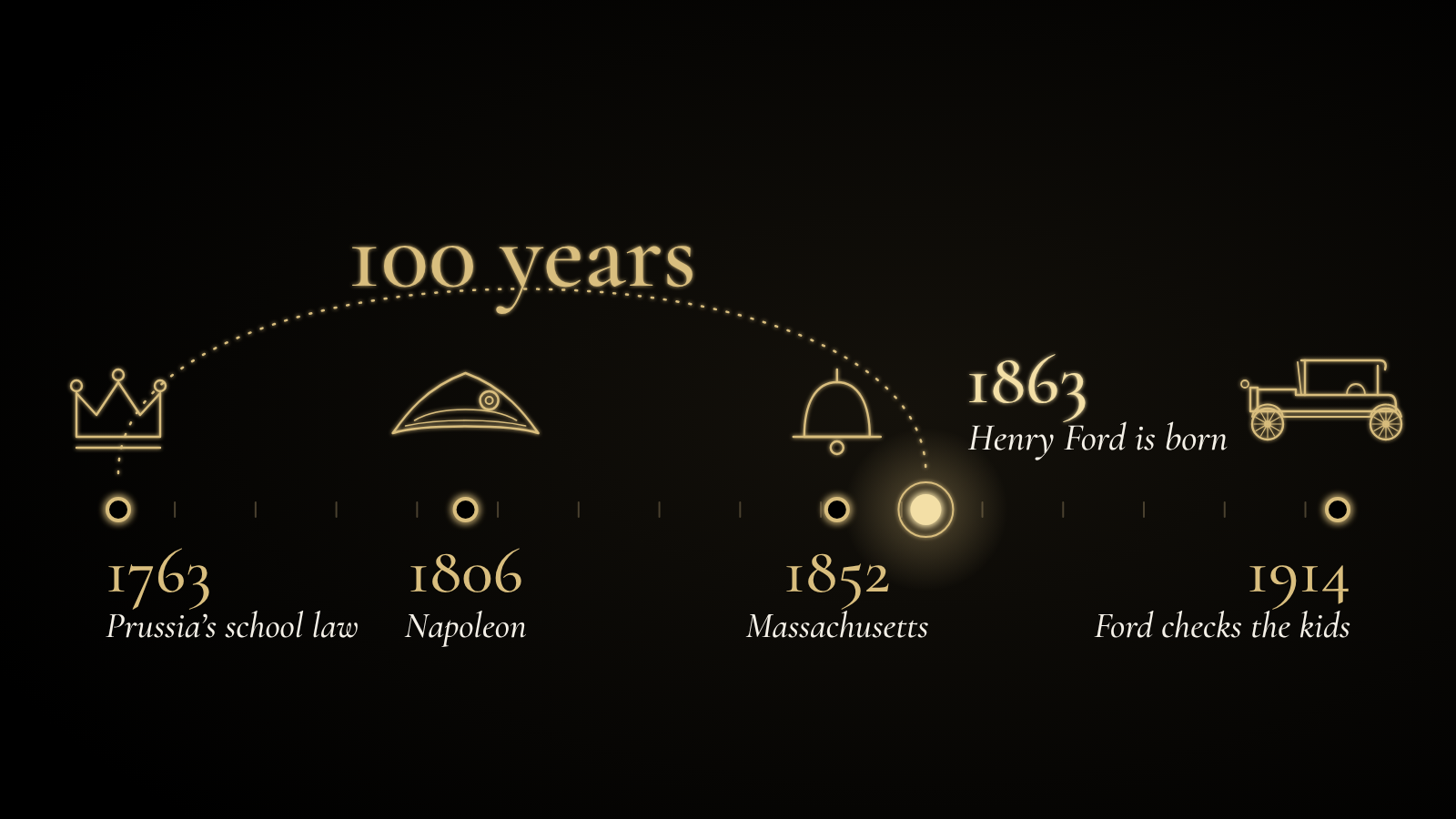
Massachusetts passed a law making school attendance required in 1852. Henry Ford was born in 1863. That is eleven years later.
A man cannot design a school system that was already running before he was born.
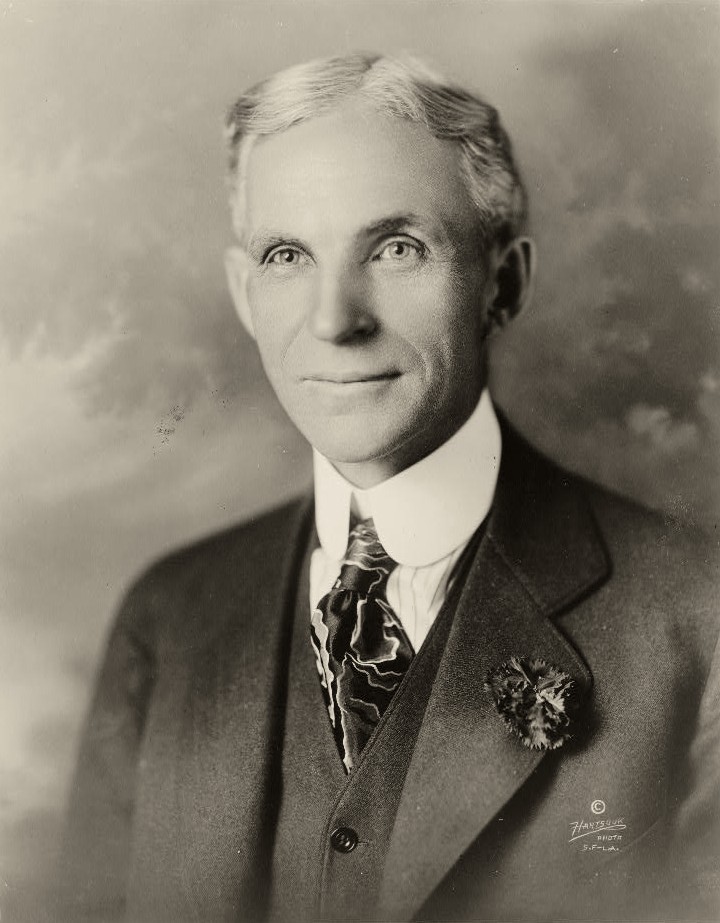
Henry Ford, the name the factory story usually brings up. He was born in 1863, eleven years after Massachusetts made school required by law.
The other popular version starts in Europe, in a kingdom called Prussia.
In the early 1800s, Prussia was one of the most powerful kingdoms in Europe. It covered much of what is now northern Germany and Poland, and it was known for its army.
In 1806, Napoleon, the emperor of France, was taking over much of Europe. Prussia went to war with him and lost badly.
According to this version, Prussia then rebuilt its schools to produce obedient soldiers and loyal citizens, so it would never lose like that again. Other countries copied it.
This version is closer to the truth than the Henry Ford one.
It goes further back than that.
Prussia already had a school law more than forty years before that war. It set the hours children were in school, which books they read, who was allowed to teach them, and the notes teachers kept on every child.
So the defeat did not create the school system. It already existed. After 1806, Prussia kept the same schools and started giving them a new purpose.
That kept happening. Under the king, school was for making better subjects. After the defeat, it was for rebuilding the nation. Later, in America, it was for raising good citizens for a democracy.
Three different reasons. The same school day every time.
What leaders said school was for kept changing. What children actually did all day stayed the same.
THE LAW FROM THE 1760s
In the 1760s, the Prussian king’s government passed a school law for the countryside. It said country schools had fallen apart, and that the goal was to raise "more capable and better subjects." A subject is a person ruled by a king.
The details:
Who. Every child, boy or girl, from age five until thirteen or fourteen. Eight or nine years of school.
When. In winter, eight to eleven in the morning and one to four in the afternoon. Six days a week, with two afternoons off. Thirty hours of lessons a week. No holidays. Not even at harvest.
What. Only books the church authorities had approved. Every child had to have a copy.
Who teaches. Nobody without a license. Nobody in front of a class until an inspector had checked them and signed off.
The record. Every teacher kept a register on every child. Age. Effort. Ability. Behavior. The law said no child was to be allowed to read it.
Children were not grouped by age. The school fee went up as a child moved from the alphabet to reading, then to writing and arithmetic, so families paid for what their child could do, not how old the child was. A child stayed in school until they could read, write and answer questions on the approved book.
Families who kept a child home to work still had to pay the school fee. Inspectors could also fine the parents sixteen groschen, a Prussian coin, paid to the school.
The law even went after the most common excuse. In farm villages, children were often kept home in summer to watch the cows. So local officials were told to hire a herder to watch the village cattle where they could. Once the herder was hired, "the cows need watching" was no longer a reason to keep a child home.
Keeping a child home meant paying the fee anyway, risking a fine, and losing the excuse.
Sending the child was the cheaper choice. The law made sure of it.
In the peace deal signed the summer after the defeat, Prussia’s king had to give up everything his kingdom held west of the Elbe River, and most of the land Prussia had taken from Poland. Napoleon handed it to his brother and to his allies.
In the land the king kept, the old school law stayed in force. Same hours. Same approved books. Same licensed teachers. Losing the war cost Prussia land. It did not change the rules of the school day.
What changed was the argument about what school was for. Two men gave very different answers.
The first was Johann Gottlieb Fichte, a famous philosopher. That winter, with French soldiers still in Berlin, he gave a series of public talks on how the country could recover. Those talks were published in 1808 as the Addresses to the German Nation. Lecturing children and urging them to behave was not enough, he said. A school had to shape a child so that he "simply cannot will otherwise" than his teacher wishes. In other words, raise children who cannot even want something different.
The second was Wilhelm von Humboldt, the government official actually drawing up Prussia’s school plans in those years. People who set out to change how a system works, like Humboldt, are called reformers. He wanted almost the opposite of Fichte. School should educate the whole person first, with job training coming later and kept separate. Learning Greek, he wrote, was no more wasted on a furniture maker than learning to make tables was wasted on a scholar.
One wanted children shaped. The other wanted them developed.
But both men were talking about schools that already ran on the hours, the approved books and the licensed teachers the old law had set more than forty years earlier.
By the 1830s, other countries were studying Prussia’s schools. A French philosopher wrote a report on them for the French government in 1832, and it was translated into English within about two years.
About ten years later, Horace Mann, who ran the school system in Massachusetts, toured schools in Prussia and other German states and wrote about them in his yearly report.
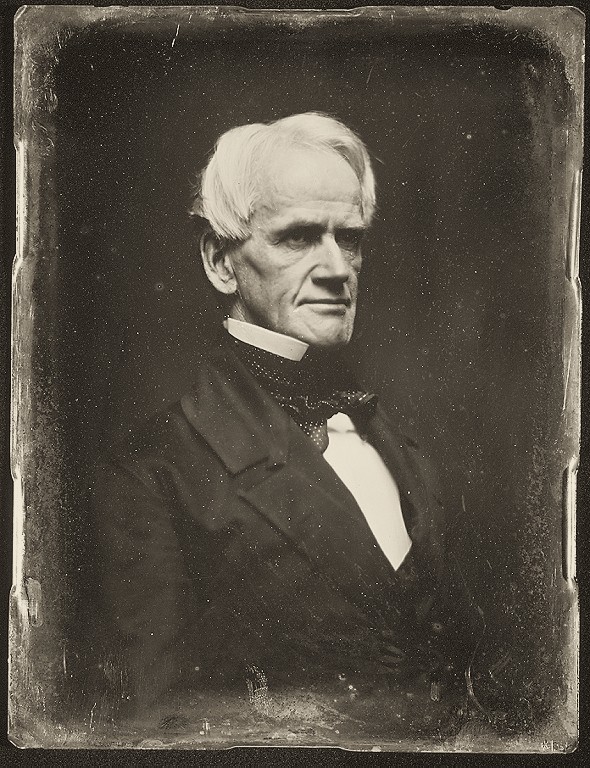
Horace Mann. He ran the school system in Massachusetts, toured Prussia’s schools, and brought their methods home.
Some Americans wanted nothing to do with it. Prussia was ruled by a king with total power, and its schools were built to serve him. America had fought a war to get away from a king.
Mann’s argument was that if Prussian teachers taught reading, writing and math better, America should copy their methods and leave their politics behind. And if a king could use schools to protect his power, a democracy could use the same tools "for the support and perpetuation of republican institutions," meaning to keep a democracy running.
That is how Prussia’s methods made it into American schools. Keep the methods, change the reason.
Even then, America was far behind. When Massachusetts finally required school in 1852, the law asked for children from eight to fourteen to attend at least twelve weeks a year. Prussia’s country law had asked for every child from age five, thirty hours a week in winter, with no holidays. That was almost ninety years earlier.
The school day stuck because it solves the same practical problems no matter who is in charge. One adult and a room full of children. A set schedule families can plan around. Books that can be checked before they reach a classroom. Teachers someone has approved. Records that let an inspector compare one school with another.
A king who wanted better subjects needed all of that. So did a reformer who wanted well-rounded people. So did a democracy that wanted good citizens.
Every one of them needed the same school day.
Kings came and went. So did the reformers. The school day stayed.
Some details did change. Later school systems grouped children by age and closed for the summer. The core did not.
Mann believed he could copy the methods without copying the message. For reading and math, he was mostly right. Arithmetic taught in Boston does not carry any loyalty to a Prussian king.
But children learned more than reading and math. Every day, someone else set their schedule, chose their lessons and graded their work. Eight or nine years of that, starting at age five, teaches a child that someone else decides how a person’s time is spent, what they learn, and how they are judged.
The school day taught it every day.
That is why the factory story feels true. It just has the order backwards.
The factory workday did not start with Henry Ford either. It started in England in the 1700s. By 1700, an ironworks owned by a man named Ambrose Crowley already had a time-keeper who wrote down, to the minute, when each worker came in and when they left. Late workers were fined. Nobody was allowed to go by any clock except the company’s.
Those early factory owners had a problem. Most of their workers grew up on farms, where work was done by the task and the season, not by the clock. They had to be taught to show up at a set hour. Some writers at the time saw school as the place to start. In 1772, one English writer proposed that charity schools, the free schools for poor children, put children to work as soon as they could learn the alphabet. By six or seven, they would be "habituated, not to say naturalized to Labor and Fatigue." Meaning: so used to hard work that it would feel natural.
Henry Ford came more than a hundred years later, and he had the same problem on a bigger scale.
In 1913, his plant in Detroit started using a moving assembly line. Each worker did one small job, over and over, at the speed of the line. The work was so dull that many workers simply quit. That year, Ford’s turnover hit 370 percent. For every job on the line, Ford was hiring almost four people a year.
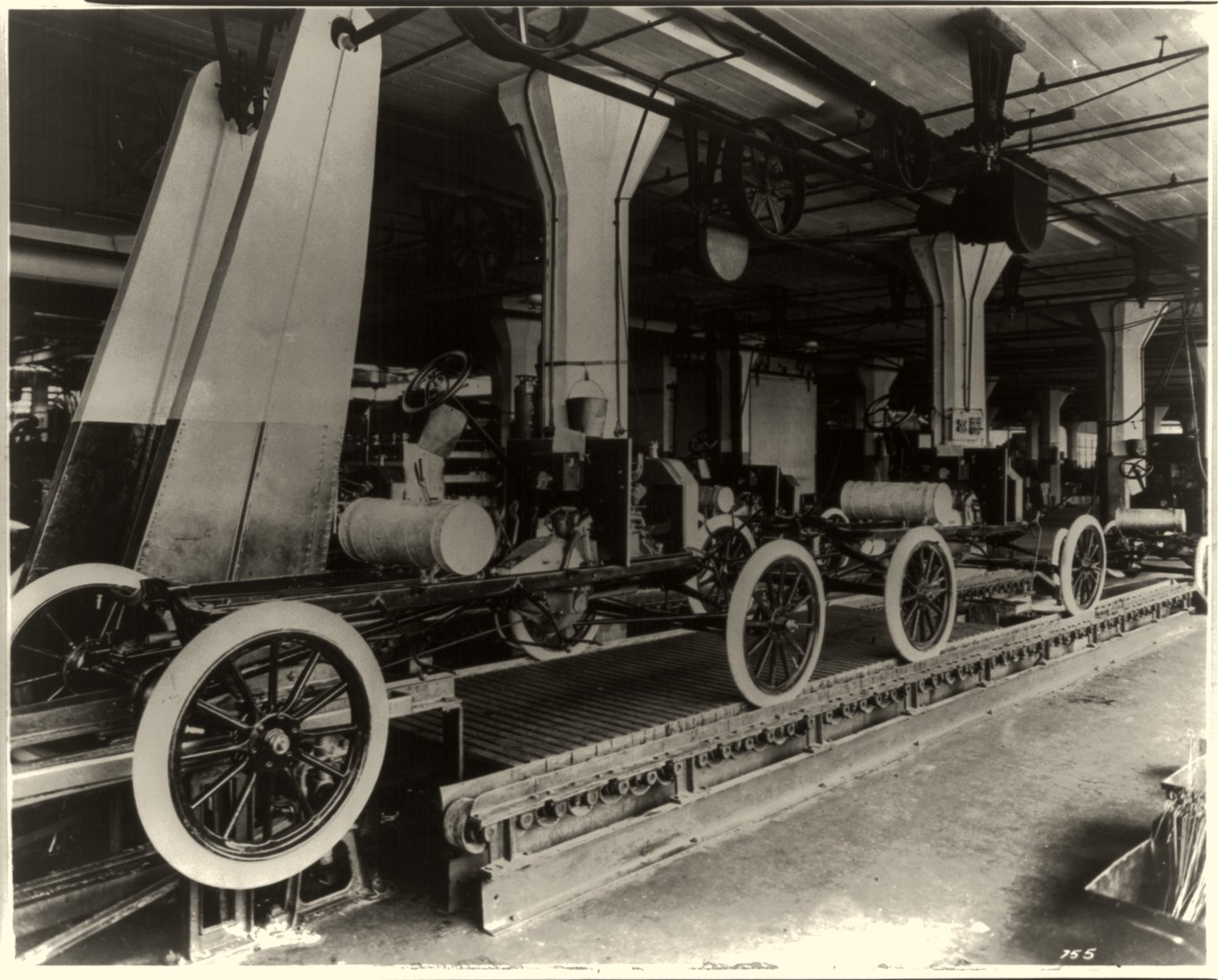
Ford’s moving assembly line. Each car rode the line from one worker to the next, and each worker added one part.
So on January 5, 1914, Ford doubled pay to five dollars a day. But the extra money came with conditions. Company investigators showed up at workers’ homes without warning. They checked whether the house was clean and whether the worker drank alcohol. They checked whether the family took in boarders and whether the worker was putting money in the bank.
And they checked whether the worker’s children were in school.
A worker who failed the check did not get the full five dollars until the problem was fixed.
So Ford was making his workers send their own kids to school. If they did not, he held back part of their pay.
A Prussian king in the 1760s. An American car maker in 1914. Same rule: keep the child in school, or the family pays.
Look at what Ford was paying for. Show up at the set hour. Do the job you are given, the way you are told. Let someone else keep a file on you and decide whether you have earned your pay.
Put that next to the Prussian school day. Set hours. Assigned work. An approved person in charge. A record someone else keeps.
Ford did not copy the school. There is no record that he ever studied Prussian schools.
But he had been through a version of the school day himself. As a boy in rural Michigan, he sat in a country schoolhouse reading the McGuffey Readers, the schoolbooks millions of American children learned from. He liked them so much that in 1930 he had the whole series reprinted for the schools he ran.
Ford said the assembly line came "in a general way from the overhead trolley that the Chicago packers use in dressing beef." In plain terms: in Chicago’s meatpacking plants, each carcass hung from a hook on a rail overhead and moved from one worker to the next, and each worker made one cut. The packers took an animal apart one cut at a time. Ford’s line put a car together one part at a time.
The home inspections were run by a department his head of personnel, John R. Lee, set up in 1914 to decide who qualified for the five dollars.
What Ford built was a factory that needed the same habits the school day had been demanding since the 1760s. And many of his workers had never sat through that school day. They came from farms, or from other countries.
So Ford went into schooling himself. In 1913, he opened an English school for his immigrant workers, held before or after their shifts. At graduation, the students walked into a giant pot on stage labeled "AMERICAN MELTING POT" dressed in clothes from their home countries, and walked out the other side in American suits, waving flags. In 1916, he opened a trade school for boys from twelve to nineteen. They split their time between the classroom and the factory shop, and they were paid by the hour.
That same year, Ellwood Cubberley, a Stanford education professor, wrote in a textbook for school administrators: "Our schools are, in a sense, factories in which the raw products (children) are to be shaped and fashioned into products to meet the various demands of life. The specifications for manufacturing come from the demands of twentieth-century civilization, and it is the business of the school to build its pupils according to the specifications laid down."
In plain terms: decide what kind of person society needs, then build the children to match.
By 1916, a factory owner was running schools, and the people running schools were calling them factories.
That is where the Henry Ford story comes from. The people sharing it are seeing something real. School and the factory did fit together. They just have the order wrong.
The school day came first. The factory just put a wage on the same habits.
The public debate about school is almost always about the reason. Teach the basics. Build the nation. Raise good citizens. Train good workers. The school day underneath every one of those reasons is the part that rarely comes up.
Eight or nine years of someone else setting the hours, assigning the work and deciding whether it was good enough. Then a job that sets the hours, assigns the work and decides whether it earned a raise.
If a person goes straight from one to the other, when did they ever get the chance to decide for themselves?
Was school designed to make factory workers?
What was school designed for?
Who invented the school system, and why?
Why was the public school system created?
Did Henry Ford create the school system?
Did Rockefeller say he wanted a nation of workers?
Second edition · Revised October 2026
A note on how to read the archive →